
The Thorne supplements we recommend for sleep — what each one is actually good for, the doses the research used, and the safety details that change the decision.
By the clinical team at Blue Peak Wellness | Last clinically reviewed by Justin Little, MD · September 2026
At a glance
Evidence first
Every product here earned its place against the human research — the extract, the form, and the dose, not just the ingredient name.
Match the pattern
Sleep timing, evening arousal, nutritional gaps, and sleep that never feels refreshing each point to different products.
Client discount
The Thorne products recommended in this guide are 25% off through our client discount. How it works.
Start here
How a psychiatric practice picks supplements
We’re an evidence-based practice, and we bring the same habits to supplements that we bring to prescriptions: read the trials, check the doses, weigh the safety. One thing worth naming up front — supplement research tends to run smaller and shorter than drug research: there’s no patent payoff to fund big trial programs, and some of what exists is funded by ingredient makers. So we work the way clinicians actually work: from the available evidence, from clinical experience, and from a healthy respect for what patients tell us helps. We wrote this guide to answer the questions our patients ask us most.
You don’t need a diagnosis to be here. Most people reaching for a sleep supplement are dealing with a body clock that has drifted late, evenings that won’t wind down, or sleep that never feels refreshing — so this guide is organized around those real situations, because matching the product to the pattern is most of the game. A consistent schedule, morning light, and less late caffeine and alcohol move the needle too; supplements are the lane this page covers.
Months of bad nights — or wondering if something else is disrupting your sleep?
Supplements work best as support, not as a substitute for evaluation and treatment. Our clinical page on sleep and insomnia — symptoms, evaluation, and what actually helps covers CBT-I, medication, and sleep disorders like apnea and restless legs in depth. This guide is written for adults.
Disclosure: Blue Peak Wellness Co. has a professional and financial relationship with Thorne and may receive compensation when customers connected to our professional account make qualifying purchases. That relationship did not determine which products are included, excluded, or recommended. Purchasing supplements is entirely optional and never a condition of care at Blue Peak Wellness Co. — you are welcome to buy anything we discuss wherever you prefer, and our guidance is the same either way.
Why these
The supplements we actually recommend
These are the supplements we suggest when patients ask what’s worth taking for sleep. Before anything earns that spot, it gets the same checks as any recommendation we make: real human evidence, in people who resemble the person asking, with outcomes that mean something — and a hard look at how closely the extract, form, and dose in the bottle match what was studied. A capsule that shares only an ingredient name with the research doesn’t get recommended.
Why Thorne, specifically? Beyond the evidence fit of individual products, Thorne’s manufacturing is a real differentiator: every product goes through four rounds of testing from raw materials through finished-product stability. That doesn’t make an ingredient effective — but it gives us real confidence in consistency and label accuracy, which is where many supplement brands quietly fail — independent analyses have found mislabeled CBD extracts and melatonin gummies far off their labels.
Hold that bar up to the wider sleep-supplement market and most of it falls over — mislabeled gummies, proprietary blends that hide their doses, botanicals with real safety baggage. We name the categories worth skipping below.
Quick decision guide
Which Thorne supplement fits your sleep problem?
Start with your primary concern, not with the most popular product. Details, evidence, and safety for each are below.
| Your primary concern | Start with | Also consider | Keep in mind |
|---|---|---|---|
| Jet lag — crossing time zones and paying for it | Melaton-3 (3 mg) | — | Timing at the destination bedtime matters more than the dose |
| Night-owl drift — bedtime keeps sliding later | Melaton-3 | — | A timing signal taken 1–2 hours before your target bedtime — not a knockout pill |
| Evenings that won’t wind down — tension, a busy mind | L-theanine | PharmaGABA | A different target — arousal, not the body clock; both live in our anxiety & stress guide |
| Poor sleep — restless nights, difficulty winding down | Magnesium Bisglycinate | Magnesium Glycinate capsules | Evidence is modest; benefit may be greater when dietary magnesium intake is low |
| Sleep that never feels refreshing | Glycine (3 g) | Melaton-3 if timing is also off | Preliminary evidence — a low-risk experiment, not an established treatment |
| Chronic insomnia — months of bad nights, tired days | Professional treatment | — | CBT-I is first-line; supplements support treatment rather than replace it — see our take |
| Loud snoring, gasping awake, or restless legs | Clinical evaluation | — | These point to a different diagnosis — no supplement here addresses them |
Before you buy anything
Order Thorne through Blue Peak Wellness
We hold a Thorne practitioner account, which means a Thorne account connected to our practice receives our client pricing on eligible Thorne products — applied automatically by Thorne, on every order, not just the first. The product links on this page are for convenience — to get the discount, you’ll first need to create a Thorne account connected to our practice.
For sleep timing
Thorne Melaton-3 for jet lag and a drifting sleep schedule
If your problem is when sleep happens — jet lag, a bedtime that keeps sliding later, a night-shift schedule — melatonin is our first suggestion. It is primarily a timing signal rather than a sleeping pill, and that is exactly why it works best when sleep timing is the problem.
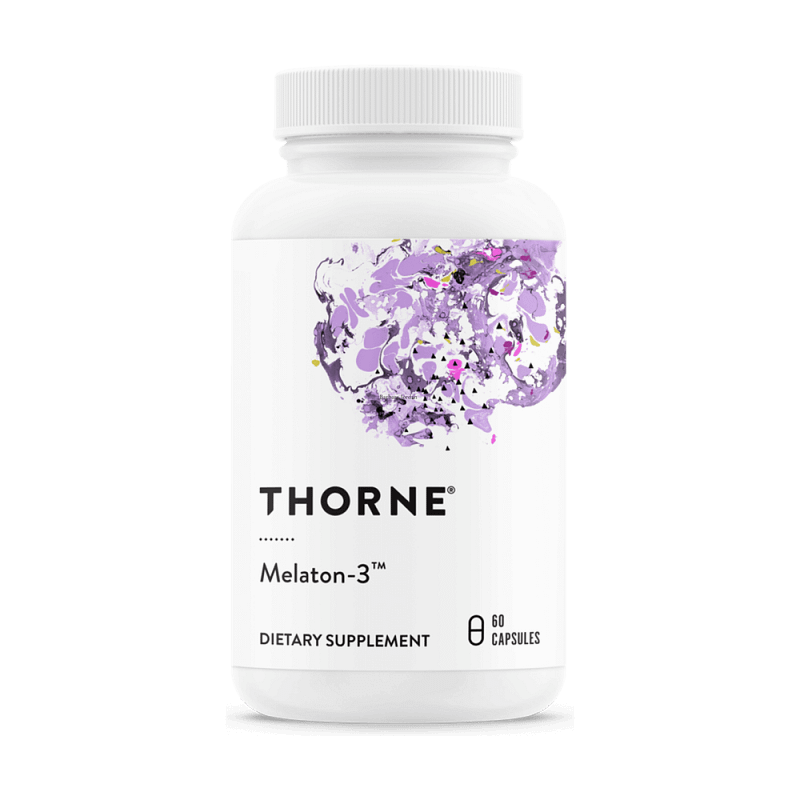
Featured · Sleep timing
Thorne Melaton-3 (3 mg)
Melaton-3 provides 3 mg of melatonin per capsule — inside the 0.5–5 mg range a Cochrane review found effective for jet lag when taken around the destination bedtime. For pulling a late body clock earlier, timed melatonin is guideline-supported, and lower doses can be enough: a key randomized trial shifted sleep timing with just 0.5 mg plus a consistent schedule.
For chronic insomnia itself the picture is different: pooled trials show small average effects, and the American Academy of Sleep Medicine suggests not using melatonin routinely for ongoing sleep-onset or sleep-maintenance insomnia. Use it for timing, not as a nightly knockout pill.
Studied dose
1–3 mg is plenty — 5 or 10 mg generally adds nothing but next-day grogginess. The jet-lag research spans 0.5–5 mg.
Timing
1–2 hours before your target bedtime when you’re shifting sleep timing; around the destination bedtime for jet lag. When you take it matters more than how much.
Not for you if
You’re pregnant or nursing (per the label), you take blood thinners or have epilepsy (review first), or your real problem is waking at 3 a.m. — melatonin doesn’t fix that. Details in the safety section.
Bottom line: the best fit when sleep timing is the problem — jet lag, a drifting bedtime, shift work. Thorne also makes Melaton-5, but more melatonin isn’t better melatonin; start at 3 mg or less and let the timing do the work.
Want 25% off? See how our client discount works →
For poor sleep
Magnesium: the nutrient people ask about most
Magnesium has a big reputation for sleep, and the evidence has recently gotten a little more interesting: beyond the older, small trials in older adults, a 2025 randomized placebo-controlled trial in adults with poor sleep found a modest benefit. The honest framing: it may help some adults with poor sleep — the effect is small, benefit looks more likely when dietary intake is low, and you don’t need a proven deficiency for it to be a reasonable trial. Many adults don’t reach recommended intake from food anyway.

Nutritional pick · Poor sleep & low intake
Thorne Magnesium Bisglycinate
A lightly sweetened powder delivering 200 mg of elemental magnesium per scoop as magnesium bisglycinate — a well-absorbed, well-tolerated form that is gentle on digestion, and NSF Certified for Sport. The evidence is modest but real: a 2025 randomized, double-blind trial of 155 adults with poor sleep found that four weeks of 250 mg/day of elemental magnesium as bisglycinate improved insomnia-severity scores modestly more than placebo — a small effect, with an exploratory hint that lower dietary intake predicts a larger response. Thorne’s scoop is close to, though not identical to, that studied dose. Prefer capsules to powder? Thorne’s Magnesium Glycinate delivers 120 mg of elemental magnesium per capsule, same gentle form.
Labeled use
One scoop (200 mg elemental magnesium) mixed with water daily — evening is the natural fit here.
Not for you if
You have significant kidney disease — magnesium can accumulate, so get guidance first. And space it away from certain antibiotics, osteoporosis medications, and thyroid medication, whose absorption it can reduce; the safety section has the specifics.
Bottom line: a reasonable, low-risk trial for poor sleep with a modest expected effect — and the more sensible it is nutritionally (thin diet, low intake), the better the odds it earns its place.
Magnesium glycinate vs citrate for sleep
Neither form has been shown to be uniquely effective for sleep — the trials used a mix of preparations. The practical difference is tolerance: glycinate and bisglycinate are bound to the amino acid glycine and tend to be gentle on digestion, while citrate absorbs well but leans laxative as the dose climbs — exactly what you don’t want overnight. Skip bargain magnesium oxide either way: it’s cheap because it’s poorly absorbed, and it’s the form most likely to cause diarrhea.
For sleep quality
Glycine: a simple amino acid with a sleep-quality signal
For sleep that comes but never feels refreshing, glycine is the low-burden experiment worth knowing about. The honest expectation is a modest improvement in how sleep feels and how the next morning goes — not a sedative effect.

Secondary pick · Sleep quality
Thorne Glycine (500 mg capsules)
Glycine is an inhibitory neurotransmitter with a plausible mechanism — it nudges core body temperature down, part of how the body initiates sleep. Small studies giving 3 g before bed reported better subjective sleep quality and next-day performance in healthy and sleep-restricted adults. The research base is small and comes largely from one research group, which is why this is a secondary pick rather than a headline recommendation.
It’s an experiment worth running properly: the studied dose is 3 g — six of Thorne’s 500 mg capsules — so decide up front whether that’s a routine you’ll actually keep.
Studied dose
3 g about an hour before bed — the dose the sleep studies used. There’s no evidence more works better.
Worth checking
Generally well tolerated. If you have significant medical illness or a long medication list, run it past your prescriber like anything else you take.
Want 25% off? See how our client discount works →
Stress and sleep
When stress is what’s keeping you up
A lot of “sleep” problems are really stress problems that clock out late: tension that peaks in the evening, a mind that won’t idle, sleep that breaks under a demanding season. The products with the best evidence for that pattern — ashwagandha for ongoing stress, L-theanine for evening arousal, PharmaGABA for winding down — are covered in depth in our anxiety & stress guide, cards, doses, and safety included.
One of them is worth naming here: Thorne’s ashwagandha (Shoden, 120 mg) matched a six-week randomized trial in adults with non-restorative sleep, improving both how sleep felt and how it measured. If unrefreshing sleep rides along with sustained stress, that guide is the better starting point than anything on this page.
Working on both at once?
Start one mood-active product at a time, whichever guide it comes from — calming supplements stack their sedation, and you’ll want to know which one actually helped. The safety section covers the combinations that deserve a check.
Waking at night
What about waking in the middle of the night?
This is the weakest category for supplements, and we’d rather tell you that than sell to it. No supplement here — or anywhere else — has strong, reproducible evidence for repeated awakenings or early-morning waking. When waking is the pattern, the useful move is to ask what’s doing the waking: alcohol wearing off, pain, reflux, a full bladder, hot flashes, an inconsistent schedule — or a sleep disorder that deserves a name.
Snoring, gasping, restless legs
Loud snoring, waking gasping, and marked daytime sleepiness point toward sleep apnea; an evening urge to move your legs that eases with movement points toward restless legs, where low iron stores can be a treatable contributor. Both are diagnoses, not supplement targets — our clinical page covers how each is evaluated.
If mood is part of the picture
Depression and anxiety both fragment sleep, and treating them is often what fixes the nights. Persistent early-morning waking with low mood is worth an evaluation in its own right — start with our depression or anxiety page rather than a bottle.
Insomnia
What about chronic insomnia?
Chronic insomnia disorder. No supplement — from Thorne or anyone else — is an established treatment for chronic insomnia disorder; cognitive behavioral therapy for insomnia (CBT-I) has earned first-line status in every major guideline, and that is where the conversation should start. (For completeness: a 2 mg prolonged-release melatonin has its own evidence stream in adults 55 and older — a formulation Thorne doesn’t make, and those results don’t transfer to Melaton-3 or Melaton-5.) If bad nights have run for months and your days are paying for it, an evaluation will do more than a new bottle.
Why we lead with that. The honest frame for everything on this page: supplements can support sleep around the edges — timing, tension, nutrition — but treating chronic insomnia by cycling through bottles usually costs months. CBT-I works on the thing that keeps insomnia running, and its results hold after the treatment ends — a claim no bottle on this page can make.
Start with treatment that’s earned its evidence
For chronic insomnia, CBT-I is the first-line treatment, with medication a case-by-case addition — and supplements work best alongside, not instead. Our clinical page on sleep and insomnia walks through evaluation, CBT-I, medication, and the sleep disorders that masquerade as insomnia.
What we’d skip — and why none of it is in Thorne’s catalog
The sleep-supplement aisle is crowded with products that wouldn’t survive the vetting above. A few categories we’d steer around entirely:
Kava
Real calming evidence — and documented cases of severe liver injury that led several countries to pull it from shelves. There’s a reason it’s not in Thorne’s catalog.
CBD
When researchers tested CBD products sold online for a JAMA study, fewer than a third contained what the label claimed — and a randomized trial of nightly CBD for insomnia came up empty. Add drug interactions and it’s an easy pass.
Unverified melatonin gummies
When melatonin gummies were lab-tested for a JAMA analysis, most were mislabeled — from no melatonin at all to more than triple the label. That’s a quality-control problem, not proof the gummy format itself is inferior — but with an unverified brand you can’t know what dose you’re actually getting.
“PM” blends & bargain magnesium
If a label hides its doses inside a proprietary “PM blend,” you can’t compare it to any study — which is usually the point. Every Thorne product on this page discloses its exact doses and forms.
A few Thorne products people ask about sit this guide out: Valerian Root because its efficacy evidence is unreliable and major insomnia guidelines recommend against routine use; Deep Sleep Complex because the finished formula hasn’t been studied as a product; 5-HTP because its serotonergic cautions outweigh its thin sleep evidence; and the Sleep Stack bundle, because convenience isn’t evidence of synergy — start with one product and a specific target. (Thorne’s Sleep+ has been discontinued.) Ashwagandha, L-theanine, and PharmaGABA belong to our anxiety & stress guide, where each gets its own card.
Safety
Supplements and psychiatric medications: the checks that matter
“Natural” doesn’t mean interaction-free. Each row below can change which product makes sense for you — and a five-minute check with your prescriber or pharmacist settles most of them.
| If this applies to you | Pay closest attention to | What to do |
|---|---|---|
| Sedating medications — benzodiazepines, hydroxyzine, gabapentin, trazodone, sleep aids, alcohol | Melaton-3, glycine | Start low; watch for added drowsiness and next-day grogginess |
| Blood thinners — anticoagulants or antiplatelets | Melaton-3 | Melatonin may potentiate blood thinners — review before use |
| Epilepsy or seizure medication | Melaton-3 | Review with your prescriber first |
| Certain antibiotics, osteoporosis medication, or thyroid medication | Magnesium | Space doses apart — magnesium binds tetracyclines, quinolones, and bisphosphonates in the gut, and can reduce levothyroxine absorption (separate by about four hours) |
| Significant kidney disease | Magnesium | Magnesium can accumulate — get guidance first |
| SSRIs, SNRIs, or other psychiatric medication | Everything here | Usually workable — bring the list to your prescriber and settle it in one conversation |
| Pregnancy, breastfeeding, or trying to conceive | Melaton-3 — and follow every label | Melaton-3’s label says don’t use; when in doubt, ask first |
| Surgery scheduled | Anything sedating | Tell the surgical team what you take; stopping beforehand is often advised |
Everything on this page is dosed and studied in adults, and older adults or anyone on several medications deserves a closer look across the board.
A smarter trial
How to try a supplement so you actually learn something
- Pick one specific target. “Asleep by 11” or “waking up actually rested” beats “sleep better” — you can actually tell whether it happened.
- Match the product to that target, using the sections above — not whichever formula has the most ingredients.
- Start one sleep-active product at a time, so you can attribute benefits and side effects to the right thing.
- Note your baseline — bedtime, time to fall asleep, night wakings, and how mornings feel — before the first dose.
- Judge on the evidence-relevant timeframe. Melatonin can work the first night — its job is timing. Magnesium and glycine deserve a couple of weeks. More isn’t automatically better — use the evidence-aligned dose rather than escalating on your own.
- Stop and reassess if you notice next-day grogginess, worsening sleep, unusually elevated or impulsive mood, or anything else concerning — and loop in your prescriber.
Get professional care rather than another bottle when insomnia persists, interferes with work or relationships, or comes with loud snoring, gasping awake, restless legs, significant depression or anxiety, or substance use. Sleeping very little without feeling tired — especially with unusually elevated or impulsive mood — deserves prompt evaluation. Urgent help — call or text 988, or go to the nearest emergency room — is the right move for suicidal thoughts, inability to stay safe, mania, or rapidly worsening symptoms. A supplement should never delay that.
Common questions
Thorne supplements for sleep, answered
What is the best Thorne supplement for sleep?
It depends on your pattern. If sleep timing is the problem — jet lag, a bedtime that keeps drifting later — Melaton-3 has the clearest use case. If your magnesium intake is low, Magnesium Bisglycinate is the nutritional pick. Glycine 3 g is a reasonable low-risk experiment for sleep that never feels refreshing. And if stress is what’s keeping you up, the best-matched options live in our anxiety & stress guide. No Thorne supplement is an established treatment for chronic insomnia disorder — for that, CBT-I remains first-line.
How much melatonin should I take for sleep?
1–3 mg is plenty — 5 or 10 mg generally adds nothing but next-day grogginess. For shifting your sleep timing, take it 1–2 hours before your target bedtime; for jet lag, around the destination bedtime. The research spans 0.5–5 mg, and a key trial shifted a late body clock with just 0.5 mg — with melatonin, when you take it matters more than how much.
Is it safe to take melatonin every night?
Short-term use is generally well tolerated — sleepiness, headache, dizziness, and nausea are the common complaints — but long-term nightly use is less studied. Melatonin is a timing signal, so needing it every night for months is itself worth a conversation with your prescriber. Per the label, skip it if you’re pregnant or nursing, and review it first if you take blood thinners or have epilepsy.
Does magnesium actually help you sleep?
Modestly, for some people. A 2025 randomized trial in adults with poor sleep found 250 mg/day of elemental magnesium as bisglycinate improved insomnia-severity scores a little more than placebo over four weeks — a small effect, and possibly larger when dietary intake is low, though a documented deficiency wasn’t required for benefit. The older trials are small and low-certainty. No form is uniquely proven for sleep; glycinate and bisglycinate are simply gentler on digestion than citrate, and far better absorbed than bargain magnesium oxide.
How much glycine should I take for sleep?
3 g about an hour before bed is the dose the research used — six of Thorne’s 500 mg capsules. The studies are small and preliminary, reporting better subjective sleep quality and next-day performance in healthy adults, so treat it as a low-risk experiment with a specific target rather than an established treatment. There’s no evidence more works better.
What actually works for chronic insomnia?
Cognitive behavioral therapy for insomnia (CBT-I). It’s first-line in every major guideline, it outperforms what most people expect from any pill, and its results hold after treatment ends. Medication has a legitimate case-by-case role alongside it. No supplement, from Thorne or anyone else, is an established treatment for chronic insomnia disorder — our sleep & insomnia clinical page covers how evaluation and CBT-I work.
Can I take these supplements with an SSRI or other psychiatric medication?
Often yes, but it depends on the combination. Melatonin can add to sedation alongside benzodiazepines, hydroxyzine, trazodone, or other sedating medication, and it deserves review if you take blood thinners or seizure medication. Magnesium mainly needs spacing from certain antibiotics, osteoporosis medications, and thyroid medication (levothyroxine). The safety section above lists the specifics — bring it to your prescriber and settle it in one conversation.
What helps with waking up in the middle of the night?
This is the weakest category for supplements — nothing here has strong evidence for repeated awakenings or early-morning waking. The useful move is finding the cause: alcohol, pain, reflux, a full bladder, hot flashes, an inconsistent schedule — or sleep apnea or restless legs, which deserve evaluation. If waking is persistent and your days are suffering, CBT-I addresses maintenance insomnia directly.
FDA disclaimer: These statements have not been evaluated by the Food and Drug Administration. These products are not intended to diagnose, treat, cure, or prevent any disease.
Medical disclaimer: This guide is educational and doesn’t provide individualized medical advice, diagnosis, or treatment. Supplements can cause adverse effects and can interact with medications, medical conditions, pregnancy, surgery, alcohol, and other supplements — discuss significant symptoms and supplement decisions with a qualified healthcare professional who knows your history. Don’t stop or change prescribed medication based on this guide.
Sources
References
- Edinger JD, et al. Behavioral and psychological treatments for chronic insomnia disorder in adults: an American Academy of Sleep Medicine clinical practice guideline. J Clin Sleep Med. 2021;17:255–262.
- Sateia MJ, et al. Clinical practice guideline for the pharmacologic treatment of chronic insomnia in adults: an American Academy of Sleep Medicine clinical practice guideline. J Clin Sleep Med. 2017;13:307–349.
- Qaseem A, et al. Management of chronic insomnia disorder in adults: a clinical practice guideline from the American College of Physicians. Ann Intern Med. 2016;165:125–133.
- Riemann D, et al. The European insomnia guideline: an update on the diagnosis and treatment of insomnia 2023. J Sleep Res. 2023;32:e14035.
- Choi K, et al. Efficacy of melatonin for chronic insomnia: systematic reviews and meta-analyses. Sleep Med Rev. 2022;66:101692.
- Herxheimer A, Petrie KJ. Melatonin for the prevention and treatment of jet lag. Cochrane Database Syst Rev. 2002;(2):CD001520.
- Auger RR, et al. Clinical practice guideline for the treatment of intrinsic circadian rhythm sleep-wake disorders. J Clin Sleep Med. 2015;11:1199–1236.
- Sletten TL, et al. Efficacy of melatonin with behavioural sleep-wake scheduling for delayed sleep-wake phase disorder: a double-blind, randomised clinical trial. PLoS Med. 2018;15:e1002587.
- National Center for Complementary and Integrative Health. Melatonin: What You Need To Know.
- Cheah KL, et al. Effect of ashwagandha (Withania somnifera) extract on sleep: a systematic review and meta-analysis. PLoS One. 2021;16:e0257843.
- Deshpande A, et al. A randomized, double-blind, placebo-controlled study to evaluate the effects of ashwagandha (Withania somnifera) extract on sleep quality in healthy adults. Sleep Med. 2020;72:28–36.
- Mah J, Pitre T. Oral magnesium supplementation for insomnia in older adults: a systematic review and meta-analysis. BMC Complement Med Ther. 2021;21:125.
- Schuster J, et al. Magnesium bisglycinate supplementation in healthy adults reporting poor sleep: a randomized, placebo-controlled trial. Nat Sci Sleep. 2025;17:2027–2040.
- Touyz RM, de Baaij JHF, Hoenderop JGJ. Magnesium disorders. N Engl J Med. 2024;390(21):1998–2009.
- NIH Office of Dietary Supplements. Magnesium fact sheet for health professionals.
- Rawji A, et al. Examining the effects of supplemental magnesium on self-reported anxiety and sleep quality: a systematic review. Cureus. 2024;16(4):e59317.
- Bannai M, Kawai N. New therapeutic strategy for amino acid medicine: glycine improves the quality of sleep. J Pharmacol Sci. 2012;118:145–148.
- Bannai M, et al. The effects of glycine on subjective daytime performance in partially sleep-restricted healthy volunteers. Front Neurol. 2012;3:61.
- Hepsomali P, et al. Effects of oral gamma-aminobutyric acid (GABA) administration on stress and sleep in humans: a systematic review. Front Neurosci. 2020;14:923.
- Valente V, et al. Does valerian work for insomnia? An umbrella review of the evidence. Eur Neuropsychopharmacol. 2024;82:6–28.
- Narayan AJ, et al. Cannabidiol for moderate-severe insomnia: a randomized controlled pilot trial of 150 mg of nightly dosing. J Clin Sleep Med. 2024;20:753–763.
- Bonn-Miller MO, et al. Labeling accuracy of cannabidiol extracts sold online. JAMA. 2017;318:1708–1709.
- Cohen PA, et al. Quantity of melatonin and CBD in melatonin gummies sold in the US. JAMA. 2023;329:1401–1402.
- National Center for Complementary and Integrative Health. Kava. Liver-injury reports and regulatory actions.
- Thorne. Current United States product pages and labels for Melaton-3, Melaton-5, Magnesium Bisglycinate, Magnesium Glycinate, and Glycine. Verified against the practice’s product registry and live catalog, August 2026.
This guide is reviewed periodically and updated as the evidence and the Thorne catalog change.


